

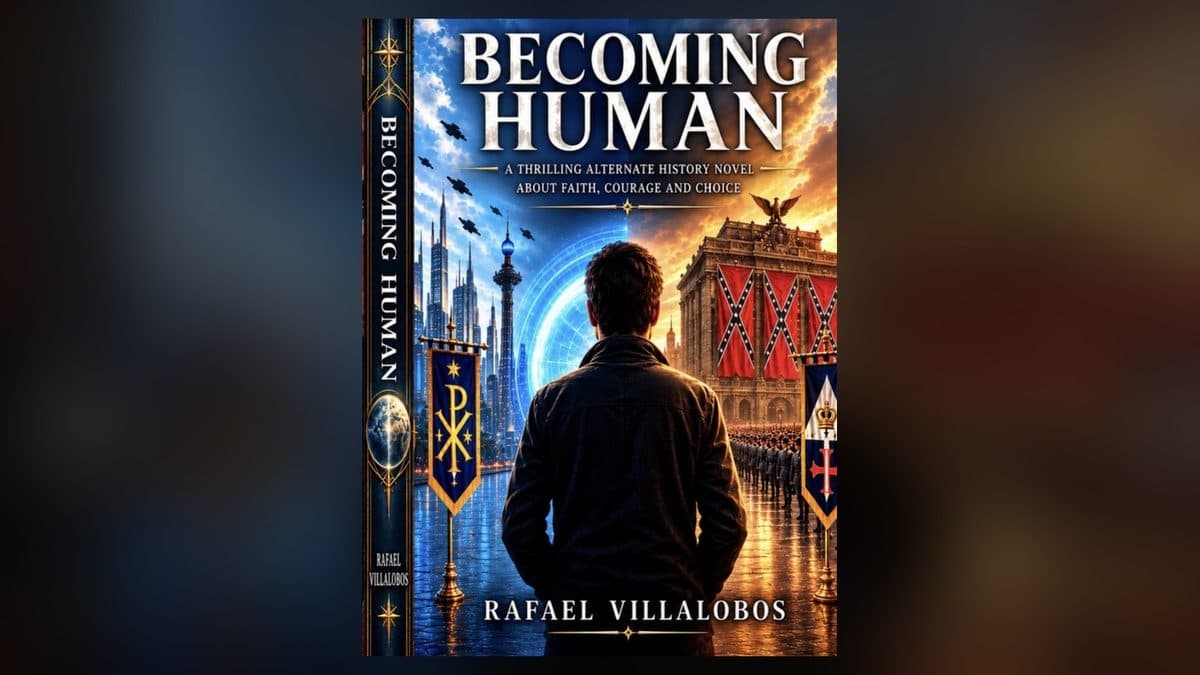
Blending alternate history, political suspense, and philosophical fiction, the novel asks whether humanity’s greatest threat has always been itself.
Civilization has never been more advanced. But has humanity truly become more human?
We have built extraordinary technologies, powerful institutions, and societies capable of achievements once considered impossible. Yet beneath these accomplishments remain the same forces that have haunted human history: the pursuit of power, the fear of difference, and the willingness to sacrifice freedom for security.
What if progress and humanity are not necessarily the same thing?
That unsettling possibility lies at the heart of Becoming Human, an alternate-history political thriller by Rafael Villalobos that challenges readers to reconsider the relationship between civilization, freedom, and moral responsibility.
Set in a radically transformed twentieth century, the novel imagines a world where history has taken a different course, authoritarian power shapes society, and the pursuit of truth threatens the foundations of political authority.
The Illusion of ProgressThroughout history, civilizations have measured their achievements through economic prosperity, military strength, technological innovation, and political influence.
Yet sophisticated societies are not immune to oppression, intolerance, or the erosion of individual freedom.
Drawing upon the literary traditions of George Orwell’s 1984, Philip K. Dick’s The Man in the High Castle, and Robert Harris’s Fatherland, Becoming Human explores the troubling contradictions of human progress.
Can a civilization call itself advanced when obedience is valued above independent thought? Can political stability justify the suppression of truth? And when freedom is surrendered gradually, at what point does society recognize what it has lost?
Through historical mysteries, political conspiracies, and speculative discoveries, Villalobos transforms these questions into a narrative of suspense and uncertainty.
The Choices That Define HumanityAt its core, Becoming Human examines a fundamental distinction: civilization represents what humanity builds, while humanity itself is revealed through the choices individuals make.
Technology can advance without compassion. Institutions can grow powerful without becoming just. Societies can prosper while abandoning the principles that make freedom meaningful.
The novel explores faith, courage, and moral conviction as forces capable of challenging seemingly immovable systems of power.
Rather than portraying history as inevitable, Villalobos invites readers to consider how individual decisions can alter the direction of entire societies.
Human progress is not guaranteed by the passage of time. It depends upon the values humanity chooses to defend.
A Question for Our TimeAlthough Becoming Human unfolds within an alternative historical reality, its underlying concerns resonate with contemporary debates about political authority, individual liberty, and personal responsibility.
The novel does not simply ask readers to imagine a different past. It challenges them to consider the future they are helping to create.
Perhaps the greatest measure of civilization is not what humanity has accomplished, but what it refuses to become.
About the AuthorRafael Villalobos is a Venezuelan-born lawyer and historian who also studied strategic management at Harvard University. He is the author of Becoming Human, an alternate-history political thriller exploring freedom, authoritarianism, and human choice.
Learn more at rafaelvillalobos.org.