


A Florida law that took effect in October has left drivers across the state uncertain about whether their license plate frames are legal, leading to inconsistent enforcement and at least one wrongful arrest.
The measure, known as House Bill 253, was signed by Gov. Ron DeSantis in May and primarily targets devices used to obscure license plates from toll readers and traffic cameras. However, widespread confusion about what the law actually prohibits has prompted state officials to issue clarifications and police departments to apologize for overzealous enforcement.
Demarquize Dawson, a 40-year-old South Florida man, spent a night in jail after Davie police arrested him over a license plate frame on his rental car. According to Dawson, the frame only covered the first letter in the phrase Sunshine State at the bottom of his plate. After his arrest, Davie Police issued an apology, stating the arrest was invalid.
"At the initial release of this updated law, the wording was vague, unclear and appeared to be open for misinterpretation," the department said in a statement. Officers have since received additional guidance on proper enforcement.
The statute upgrades violations from traffic infractions to second-degree misdemeanors, carrying penalties of up to 60 days in jail and a $500 fine. The law prohibits anything that covers, obscures or interferes with the legibility or detectability of a license plate's primary features.
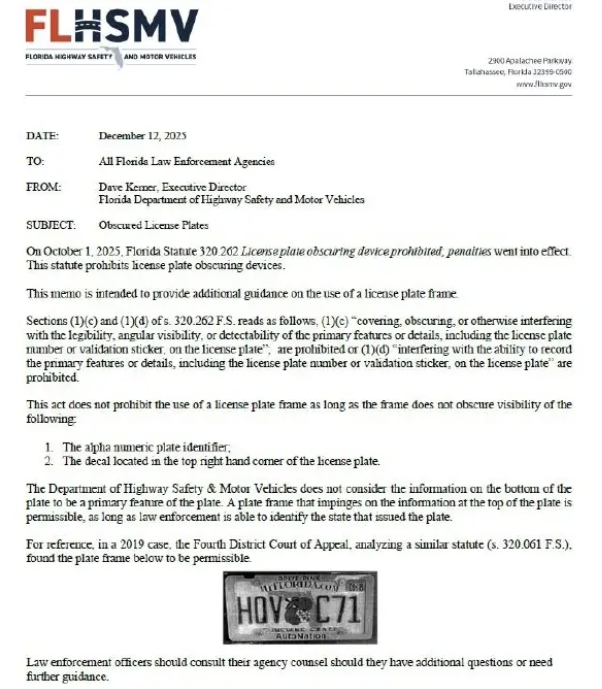
Law enforcement agencies initially offered conflicting interpretations. Some departments warned drivers that frames covering even small sections of their plates could result in citations. However, the Florida Department of Highway Safety and Motor Vehicles clarified in a December 12 memo that decorative frames remain legal as long as they do not obstruct the alphanumeric plate identifier or the validation sticker in the top right corner.
The memo also confirmed that frames can partially cover information at the top or bottom of the plate, including text like My Florida and Sunshine State, provided officers can still identify which state issued the plate.
Rachel Mattie, a criminal defense attorney with the Umansky Law Firm, said the statute contains vague language that has created enforcement problems.
"So here is the thing with this new statute, it's not actually changing much in what's allowed or not allowed, the biggest difference is how it is now going to be penalized," Mattie said. "So instead of a traffic infraction, now it's a criminal offense."
University of Miami law professor Tamara Lave also criticized the statute's language. "The law is vague, the law is badly written," Lave said. "Certainly, one of the foreseeable consequences for this law is that it allows the police to stop just about anybody."
Traffic safety expert Steven Montiero acknowledged the law gives officers broad authority to conduct stops. "Right now, the law is saying anything that obstructs that tag can get you pulled over," Montiero said. He advised drivers to ensure their frames do not cover any text anywhere on the plate.
Multiple police departments have issued public guidance attempting to clarify the rules. The Casselberry Police Department emphasized that standard frames surrounding plate information remain permitted.
"We will not be arresting people just for having a basic, simple plate frame," the department said. "Our focus is on intentional alterations, blocked characters, and unreadable plates or decals."
The law was designed to combat tag flipping, a practice where drivers use devices to hide license plates from toll readers and red light cameras. State Representative Doug Bankson, who sponsored the legislation, said viral videos falsely claimed the law banned all decorative frames.
"Since 2015, it has been legal to have such frames as long as the alphanumeric license number and state-issued sticker are visible," Bankson said. "HB 253 addresses different devices, which can be triggered from inside the vehicle to cover or obscure a license from being read by a tollbooth or avoid detection."
The law also targets tinted covers, reflective coatings and mechanical devices that flip or hide plates. Manufacturing or selling plate-obscuring devices is a first-degree misdemeanor, while using such devices to commit or flee from a crime is a third-degree felony.
Florida Highway Patrol reports that nearly 3,000 license plate violations were recorded in 2023, prompting the stricter penalties. Law enforcement officials say the law helps catch hit-and-run drivers, prevent toll fraud and combat vehicle theft.
Despite official clarifications, confusion persists. News outlets across Central Florida documented more than a dozen citations issued in the weeks after the law took effect, including tickets for frames that only partially covered decorative text.
Doral Police Chief Edwin Lopez offered simple advice for drivers uncertain about their frames: remove them entirely. "It's quite frankly, very simple as that," Lopez said.
Some drivers have followed that recommendation to avoid potential complications, while others continue to question why a law targeting sophisticated plate-obscuring devices has created so much uncertainty about ordinary decorative frames sold at dealerships and auto parts stores.