

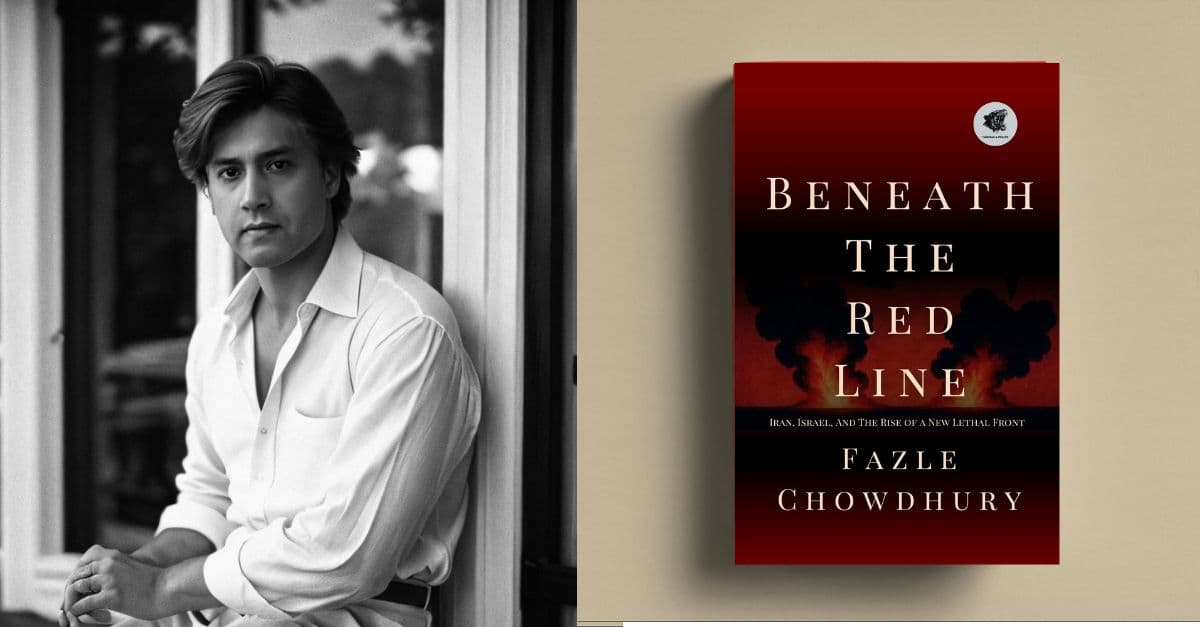
Israel’s 12-day war on Iran this past June showed that for the first time, the conflict between the two Middle East archrivals burst fully into the open, drawing the United States into the fight. But as Fazle Chowdhury—author of Beneath the Red Line: Iran, Israel, and the Rise of a New Lethal Front—warns, the violence was not an isolated eruption. It may instead be the opening act of a much larger war, one that could pull Washington even deeper into the most lethal rivalry.
Beneath the Red Line dissects how the June war erupted: a fragile balancing act collapsing under the weight of Tehran’s nuclear ambitions and proxy networks, Israel’s doctrine of preemptive defense, and a cascade of miscalculations. In the shadows, the two powers had long battled through assassinations, cyberattacks, and deniable strikes. By mid-2025, those shadows dissolved into daylight. Israel abandoned ambiguity, striking openly, and the United States followed suit.
Chowdhury warns that another confrontation is not just possible—it is likely. He views the June conflict as unfinished business for Israel. In the next round, he argues, Iran will not proceed cautiously as it did before. Instead, Iran may call on other powers for support in countering Israel’s military superiority.
For the United States, this time, the priority should be to not be an active participant and avoid another war—both to prevent being drawn into a costly conflict and to allow Donald Trump to keep his promise of bringing American troops home from the Middle East.
The escalation raises unsettling questions for the global order. Can preemptive strikes ever be squared with international law? How do ideology and national identity shape strategic risk-taking when nuclear capabilities are at stake? And how close is the line between a limited war and one that spirals far beyond its original battlefield?
Amid the collapse of diplomacy, another, quieter story persists. Across digital platforms, young Iranians and Israelis continue to connect, defying the enmity of their leaders. These fragile conversations point to an alternative future—though one constantly overshadowed by the drumbeat of war.
For Israel, the conflict has never been only about Iran’s nuclear program—it is about shifting the balance of power in the Middle East, something it cannot achieve without U.S. support. For Washington, the risk is stark: another war with Iran could become a repeat of the 2003 Iraq debacle.
The region’s most volatile rivalry is now out in the open, and the urgent question is whether the fragile peace can last—or whether, as Chowdhury warns, it will give way to the rise of a new lethal front.
Beneath The Red Line: Iran, Israel, and the Rise of a New Lethal Front by Fazle Chowdhury
Fabrezan & Phillipe, 2025
406 pp. $29.95