

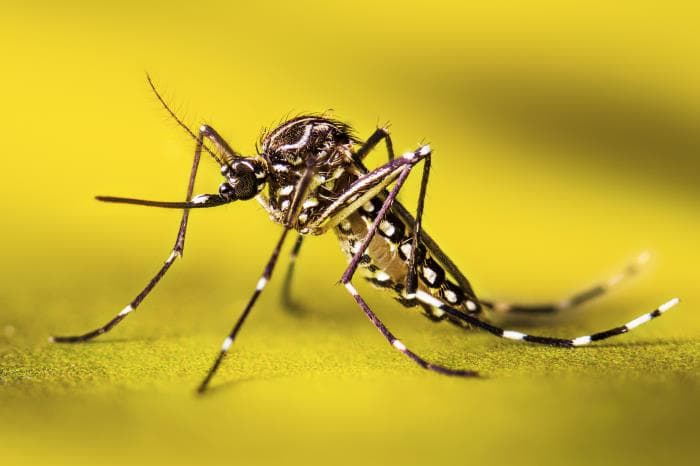
Hillsborough County now has 15 locally acquired dengue cases this year after a sharp jump in the state’s latest weekly report, and five groups of Aedes aegypti mosquitoes collected in the county tested positive for the virus. Pinellas County recorded a third local case. Both counties remain under a mosquito-borne illness alert.
The jump is a reason to dump standing water and use daytime repellent — not a reason to stay inside. Most people who catch dengue have mild symptoms or none at all. The virus is circulating in Tampa Bay mosquitoes, and the most useful steps are ones residents can do around the house after a summer rain.
The Florida Department of Health Week 32 arbovirus surveillance report, covering Aug. 9–15, lists 23 locally acquired dengue infections statewide: 15 in Hillsborough, four in Miami-Dade, three in Pinellas and one in Palm Beach. Sixteen of those local cases were newly reported that week. It is the latest official statewide tally; a Week 33 report has not been posted.
Hillsborough’s official count rose from five cases in the prior weekly report, covering Aug. 2–8, to 15. Nine of the Hillsborough cases had onset in July and six in August. All 15 have been typed as dengue virus serotype 2, or DENV-2. The county has been on a mosquito-borne illness alert since DOH-Hillsborough confirmed a second local case on July 31.
Pinellas now has three locally acquired cases, all with onset in August and also typed as DENV-2. DOH-Pinellas announced the first two on Aug. 11 — the county’s first locally acquired dengue in 15 years — and put the county on alert. The third case appears in the Aug. 9–15 statewide report.
Travel-associated cases are counted separately. The same weekly report lists 86 dengue infections tied to travel to dengue-endemic areas, including five in Hillsborough County. Pinellas was not among the counties listed for travel-associated dengue. Twenty-one of the travel-associated cases were newly reported in Week 32.
After that weekly report closed, the Florida Department of Health in Citrus County announced a confirmed locally acquired dengue case on Aug. 22 and issued its own mosquito-borne illness alert. That case is not included in the Aug. 9–15 statewide total of 23.
Five mosquito pools tested positive in Hillsborough
State surveillance found five mosquito pools — groups of mosquitoes collected and tested together — positive for DENV-2 in Hillsborough County. All were Aedes aegypti, the mosquito that can spread dengue to people. One pool was collected Aug. 6 and four on Aug. 11.
A positive pool is an early warning that the virus is in local mosquitoes, not a count of infected people. It gives mosquito-control crews a reason to inspect and treat nearby breeding sites.
What an alert means
Florida issues a mosquito-borne illness advisory when a single locally acquired case or rising animal surveillance points to higher risk. An alert is the next step: a cluster of two or more locally acquired human cases, or signs of intense virus activity. Hillsborough, Pinellas and Miami-Dade are on alert. Alachua, Leon, Palm Beach and Pasco are on the lower advisory, according to the Week 32 report.
An alert is not a stay-inside order. It is a signal to take bite prevention seriously, especially after rain that leaves water in buckets, toys, gutters and flowerpots.
How dengue spreads here
Dengue is not spread from person to person. It is spread when an infected Aedes aegypti mosquito bites someone. That mosquito is a daytime biter and breeds in small containers of standing water, often on private property — birdbaths, plant saucers, trash cans, toys, pool covers and clogged gutters. Traditional nighttime truck spraying does not always reach those backyard breeding spots, which is why Pinellas mosquito control has told residents that dumping standing water is the most effective step against these species.
What residents should do
Walk the yard after it rains and empty anything that holds water. Scrub and dump birdbaths at least twice a week. Tip flowerpot saucers, toys, buckets and coolers. Clear gutters. Cover rain barrels and trash cans. If a container cannot be dumped, mosquito-control crews can treat it.
Use an EPA-registered insect repellent with DEET, picaridin, IR3535 or oil of lemon eucalyptus on exposed skin, including during the day. Wear loose, long sleeves and pants when you can. Repair torn screens on windows, doors, porches and patios. Keep doors closed.
If mosquito-control technicians knock, let them look. Aedes aegypti often breeds in places crews cannot see from the street. Pinellas County said door-to-door inspections are especially important for that reason.
Symptoms and when to see a doctor
The Centers for Disease Control and Prevention says about one in four people infected with dengue get sick. Symptoms usually last two to seven days and can include fever with headache, pain behind the eyes, muscle and joint pain, nausea, vomiting or a rash. Florida health departments say symptoms typically appear within 15 days after an infected mosquito bite. There are usually no respiratory symptoms, which can help distinguish dengue from a cold or flu.
See a health care provider if you have a fever and those symptoms, especially if you live in Hillsborough or Pinellas or recently traveled to an area with dengue. A blood test is the only way to confirm the diagnosis. Call DOH-Hillsborough at 813-307-8010 or DOH-Pinellas at 727-824-6932 if you think you have a mosquito-borne illness.
Severe dengue is uncommon but can become dangerous quickly. The CDC says to go to an emergency room if you have belly pain or tenderness, vomit three or more times in 24 hours, bleed from the nose or gums, vomit blood, have blood in the stool, or feel extremely tired or restless — especially in the day or two after a fever breaks.
Spraying and how to report mosquitoes
Official sources have not named specific Hillsborough neighborhoods tied to the 15 local cases or the five positive mosquito pools. Hillsborough County sprays by truck and air based on trap data and health reports, not a fixed weekly route. Check the county spraying map for planned and recent treatments, sign up for spray notifications, or request a free yard inspection or neighborhood spray at 813-635-5400.
In Pinellas, mosquito control increased ground inspections and dawn truck fogging in the Palm Harbor area after the Aug. 11 alert and said it would keep up daytime backpack treatments and door-to-door inspections. Residents can check the Pinellas mosquito treatment map for current and recent work in their neighborhood.
Weekly statewide numbers are posted on the Florida Department of Health arbovirus surveillance page. Prevention guidance is also on the department’s mosquito-prevention page.