
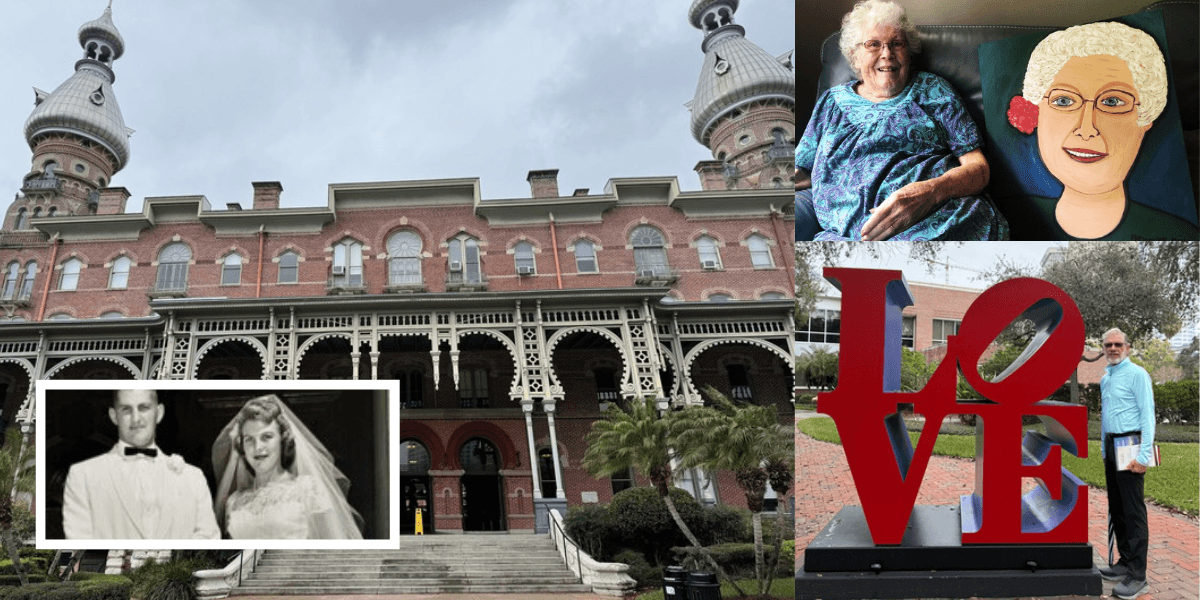
Honoring University of Tampa Alumni Beverley and Her Husband Glenn
On February 22, 2026, a sudden cold front swept across Florida. Wind moved steadily through Tampa, and light rain darkened the brick walkways of the University of Tampa.
That afternoon, Sarah Lin Lu and her husband, David, walked through the university gates with a specific purpose: to honor the memory of University of Tampa alumni Beverley and her husband, Glenn.
They were not visiting as tourists. They had come to remember.
The campus red-brick pathway appeared deeper in tone after the rain. At one point, Lin Lu crouched to photograph the walkway and quietly remarked that Beverley and Glenn must have walked there decades earlier as students. For her, remembrance was not simply about looking back—it was about stepping into the time someone once lived.
A Beginning in Tampa
Beverley traveled from Hawaii to Florida as a young woman to attend the University of Tampa. It was here that she met Glenn, who would become her husband. After graduation, she followed him to rural Pennsylvania, where the couple built a life on a farm—raising animals, swimming often, and living among open fields.
Years later, Beverley became what Lin Lu describes as her “spiritual mother.”
Beyond encouragement, Beverley offered tangible support. She purchased Lin Lu’s artwork and contributed financially to her writing, allowing her to create without distraction or financial anxiety.
“She wasn’t simply supportive in words,” Lin Lu later reflected. “She supported in substance.”
When Beverley passed away on February 5, 2025, Lin Lu did not anticipate that one year later she would stand at the place where Beverley’s adult life first began.
Seeing the Younger Versions
During their visit, Lin Lu and her husband entered a historic campus building—once a hotel, now classrooms. The second floor was active with lectures.
Standing at the doorway of a classroom, Lin Lu observed students listening to their professor. In that moment, she said, it became easier to imagine Beverley and Glenn not as elders, but as young students—full of promise, unaware of the life ahead.
To see someone in their youth, she explained, is to honor the wholeness of their life.
The visit was not nostalgic in tone. It was reflective—an acknowledgment that the elderly mentor she had known once stood in these same corridors as a young woman beginning her future.
Remembering with the Body
At one point, David pointed toward the campus pool and noted that Beverley had loved swimming.
That memory immediately connected Lin Lu to July 11, 2025, when family and friends gathered at Beverley’s farm for a memorial event. On that day, Lin Lu brought a swimsuit and swam in the family pool.
“She loved swimming,” she said. “So I swam.”
For Lin Lu, remembrance has not remained abstract. It has included physical participation—acts that allow memory to move beyond thought and into lived experience.
Green, Red, and a Return
Beverley loved the color green—the color of fields and farmland. On campus, Lin Lu wore a green floral dress in quiet tribute.
She also photographed red flowers blooming against the green landscape—colors that reminded her of Beverley’s Hawaiian roots. Later, she edited the images into a short video alongside old family photographs and planned to send it to Beverley’s daughter, who was unable to travel to Florida.
In doing so, she felt she was returning Beverley’s youth to its point of origin—placing memory back where it began.
Permission and Mutual Care
Lin Lu’s own mother was born in 1933 and passed away in 2002. Years later, when she met Beverley in 2012, she did not expect another maternal figure to enter her life. In 2014, Beverley formally offered to become her spiritual mother. Remarkably, Beverley had also been born in 1933.
What remains most vivid to Lin Lu are small, intimate moments: feeding Beverley lunch in a hospital room; trimming her fingernails with uncertain hands.
“She allowed me,” Lin Lu said. “That was trust.”
Those moments marked a shift from one-directional support to mutual care. Love, she realized, flows both ways.
Fire and Forward Motion
Later that week, on a Florida evening by the sea, David purchased tickets to a Polynesian Fire Luau—a cultural performance blending Hawaiian feast traditions with Polynesian dance and a fire finale.
Drums pulsed in the salt air. Flames spun against the night sky.
Lin Lu wore a lei and listened to Hawaiian songs that echoed Beverley’s origins. When invited, she and her husband joined the dancers for a brief lesson.
They did not only observe—they participated.
From swimming in a farm pool to walking red brick paths to dancing beside firelight, remembrance became movement rather than stillness.
A Relay Across Generations
Beverley traveled from Hawaii to Florida, then to Pennsylvania.
Lin Lu traveled from China to Pennsylvania, and later to Florida.
Across generations and cultures, both women moved for love, built new lives, and carried others along the way.
Feeding Beverley in her final days, Lin Lu realized she was no longer only someone supported by maternal love—she was becoming someone who could carry it forward.
“Love is not one-directional,” she said. “Over time, it completes a circle.”
Love Still Growing
On that rainy afternoon at the University of Tampa, Lin Lu stood once more on the red brick walkway. The wind moved across campus as it likely had decades earlier.
“She must have walked this path,” she said again.
Now, she had walked it too.
Loss, she reflected, does not erase love. Time does not end relationship. Love does not stop—it changes form.
On the red brick path in Tampa, remembrance became continuation.
And in that continuation, love still grows.