

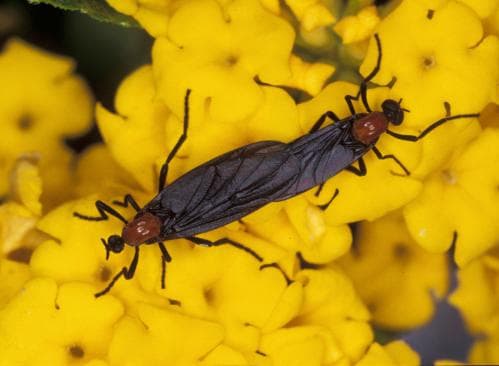
Lovebugs are making their seasonal return across the Tampa Bay area, with sightings increasing as temperatures rise.
These small black flies, known for the red markings near their heads, are most often seen flying in pairs as males and females remain attached during mating.
University of Florida (UF),Professor Dr. Normal C. Leppla, program director of integrated pest management, said lovebugs tend to be more abundant in humid areas.
"Lovebugs emerge from the soil surface as adults in about May and September. Generally, it appears that lovebugs may be more abundant in some areas of Florida this year than during May last year," he said. "Adult lovebugs occur earlier in South Florida because they develop faster in a warmer climate. Lovebugs occur in some areas and not others from year to year. They are only abundant for about two weeks in an area."
Leppla said lovebugs feed on decaying vegetation and contribute only minimally to pollination.
Populations have declined in most locations over the past four years, though the exact cause remains unknown.
Originally introduced from Mexico in the 1960s, lovebugs reached peak outbreak levels across Florida in the 1970s. Today, their presence varies by region and environmental conditions.
“We don’t know for sure how they got here, but when insects move around by themselves, we have a pretty good idea that it’s often when people help them,” Leppla said.
He said interstate highways or the movement of plant material may have contributed to their spread from Mexico to Florida.
According to UF, lovebugs are typically most active between 10 a.m. and 6 p.m., especially when temperatures exceed 84 degrees Fahrenheit.
Their peak mating seasons last about four weeks in May and again in September, though they can be spotted throughout the summer.
"They really have two basic times in their lives. One is when they're larvae and they're growing for about 120 days for the summer population. As adults, in a synchronized way, they come out together. This is part of the adult process of mating and dispersing," Lappla said.
A female lovebug can lay around 300 eggs.
Lovebugs are not poisonous and do not harm people, unlike mosquitoes.
To reduce their presence, residents can use fans to blow them away, as they are weak fliers, vacuum them indoors and install screens to keep them off porches.
“The main problem people seem to be having is damage to the paint on their cars and trucks,” Leppla said. “The white streaks on the car are from the females, and that’s what causes the damage. You want to get them off as soon as possible. The sun baking them into the paint is what leads to damage.”
Lappla said using a wet dryer sheets can remove the insects easily from vehicles.
"There are people who actually appreciate lovebugs and how, over the last few years, we don’t have as many and want to know why,” Leppla said. “Others find them really annoying. Regardless, I hope people will accept the nuisance and focus on protecting themselves from more dangerous insects like mosquitoes.”
Male lovebugs die shortly after mating. The current season typically lasts about four weeks, with another peak expected in September.