

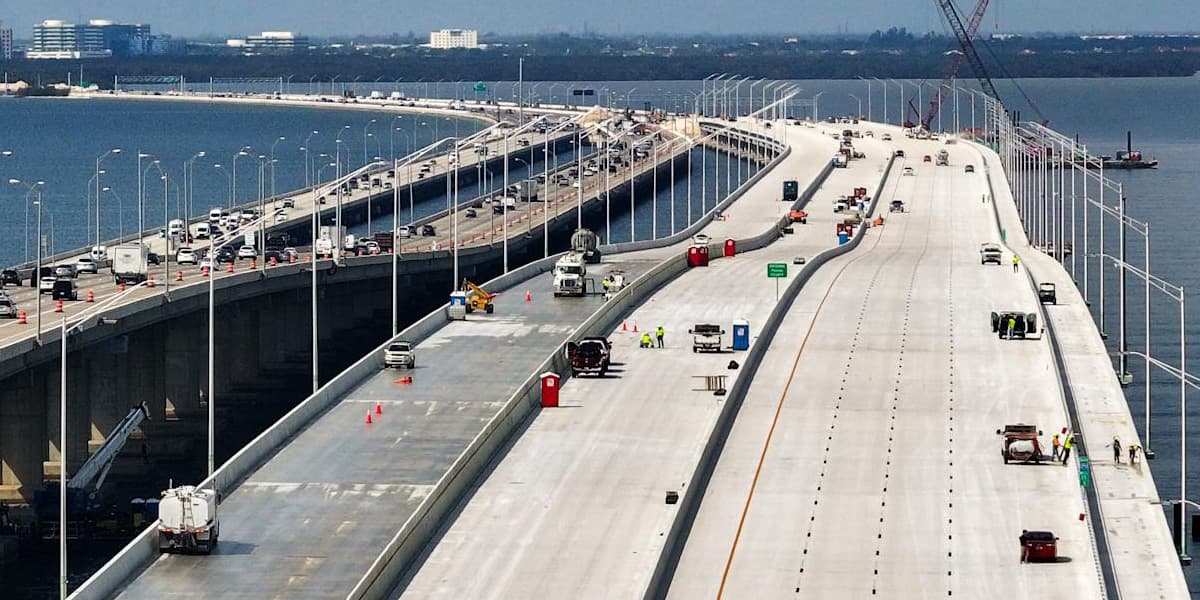
After four years of construction, the new southbound span of the Howard Frankland Bridge opened to traffic yesterday morning, marking a significant milestone in Tampa Bay's transportation infrastructure. The $865 million project represents the third incarnation of the critical six-mile connector between Tampa and St. Petersburg.
State transportation officials directed overnight lane closures on Monday to prepare for Tuesday's traffic shift, with vehicles now traveling on the new southbound lanes. The transition comes after crews completed final preparations, including painting new stripes between lanes on Interstate 275.
"The opening of the Howard Frankland Bridge expansion is an incredible accomplishment," said St. Petersburg Mayor Ken Welch. "With these critical enhancements, the Howard Frankland has greater capacity to relieve traffic congestion and meet the transportation needs of the Tampa Bay region."
The new span is part of a larger project that began in 2020 to replace the aging northbound bridge originally constructed in 1959. When fully completed, it will be the widest bridge ever built in Florida, featuring four southbound general-purpose lanes, two southbound express lanes, two northbound express lanes, and a shared-use path.
While motorists can now drive on the four new southbound lanes, the additional express lanes won't open until 2026. The existing southbound bridge, built in the 1990s, will eventually be converted to northbound lanes, and the original northbound structure will be demolished and recycled.
Greg Deese, a civil engineer with the Florida Department of Transportation, emphasized the new bridge's increased resilience against storms, a critical improvement following damage to the northbound bridge's shoulder during Hurricane Helene last year. Designers incorporated lessons from the Sanibel Causeway washout during Hurricane Ian, using sturdier rock fill instead of sand for the bridge approaches.
For commuters accustomed to congestion on the bay's busiest crossing, the immediate impact may be limited. The four express lanes remain closed, and traffic bottlenecks persist at both ends of the bridge. However, once completed, the expanded capacity aims to accommodate the region's rapid population growth and improve evacuation routes during hurricanes.
The project's completion schedule continues with a traffic shift to southbound general-use lanes next March, followed by northbound travel lanes in summer 2025. Pedestrians and cyclists will gain access to the bridge's shared-use path in spring 2026, which will include four lookout areas for travelers to take in views of Tampa Bay.
Transportation officials also designed the bridge with future needs in mind, including accommodations for potential light rail transit, though no formal plans exist from local governments to implement such a system.
The Howard Frankland Bridge, named for the Tampa businessman who proposed it, has served as the central artery across Old Tampa Bay since 1960, carrying Interstate 275 traffic between Hillsborough and Pinellas counties. By 2026, when the entire project reaches completion, officials expect significant traffic congestion reduction thanks to the additional lanes.