
Tampa City Council votes at 9 a.m. Thursday, Aug. 27, on the definitive development and funding agreement for a $2.36 billion Tampa Bay Rays ballpark at Hillsborough College’s Dale Mabry campus. A special meeting of the city’s Community Redevelopment Agency follows at 10 a.m. If Tampa approves, the Hillsborough County Commission is scheduled to take up the same package at 9 a.m. Friday, Aug. 28.
The contract would cap Tampa at $80 million and Hillsborough at about $796 million — $876 million in combined public money. The team’s stadium company would pay every other project cost, including design and all construction overruns. Both governments have to say yes before bonding and court validation can start. A no from either body stops the deal as written.
How the $2.36 billion is split
The official project budget in the Stadium Development and Funding Agreement is $2,360,930,000. WUSF, citing the exhibit, put most of that in construction, with smaller lines for design, permits and a $215 million contingency. Design is on the private side.
Public money is capped at $876,010,300: $80 million from the city and a county contribution “not to exceed” $796,010,300. Recaps of the team’s summary have put the Rays’ share at about $1.37 billion. Subtract the public cap from the published budget and the remainder is closer to $1.48 billion. The difference depends on how later write-ups count a separate $100 million in privately placed community-development-district debt. The contract itself does not lock a private-dollar figure. It says Tampa Bay Rays Stadium Company LLC, or StadCo, pays whatever the public contribution does not, plus overruns.
Tampa’s $80 million is not a loan to the Rays. Section 3.2 says the city will pay “from City legally available revenues” in four unsecured installments: $20 million on Jan. 1, 2027, then $20 million each on Oct. 1 of 2027, 2028 and 2029. The money can be used only for public horizontal improvements — streets, utilities and similar work — not the ballpark structure. The city cannot be forced to raise property taxes to make the payments. The agreement does not name a fund. Earlier drafts pointed at Community Investment Tax dollars; the final text does not. Mayor Jane Castor has said the city has not decided how it will raise the cash up front and that it “may be a line of credit,” later repaid through tax increment. That is a city cash-flow question, not a loan to the club.
Hillsborough’s $796 million uses existing county sources, not a new countywide tax: $303 million in Tourist Development Tax financing ($228 million in a first bond issue, a $40 million reserve, and a $35 million second tranche around Oct. 1, 2031, if capacity exists); $360 million in county Community Investment Tax money, in four $90 million installments; $103 million from other legally available county funds; and $30 million in federal disaster-recovery money limited to eligible stormwater work. If the state does not fully deliver a separate $100 million pledge for Lithia Pinecrest Road by the end of 2031, the county may cut its CIT share by the same shortfall. TDT proceeds are limited to public vertical improvements. None of the public contribution is supposed to buy seats, scoreboards or other personal property.
Public dollars move through a construction trust and do not go out until the team shows its financing is in place, including at least $150 million from Major League Baseball’s infrastructure facility. StadCo is solely responsible for design and construction defects. The parent company is supposed to guarantee StadCo’s performance, though County Attorney Julia Mandell said this week the guarantee and non-relocation papers were still being discussed with MLB.
The Dale Mabry site
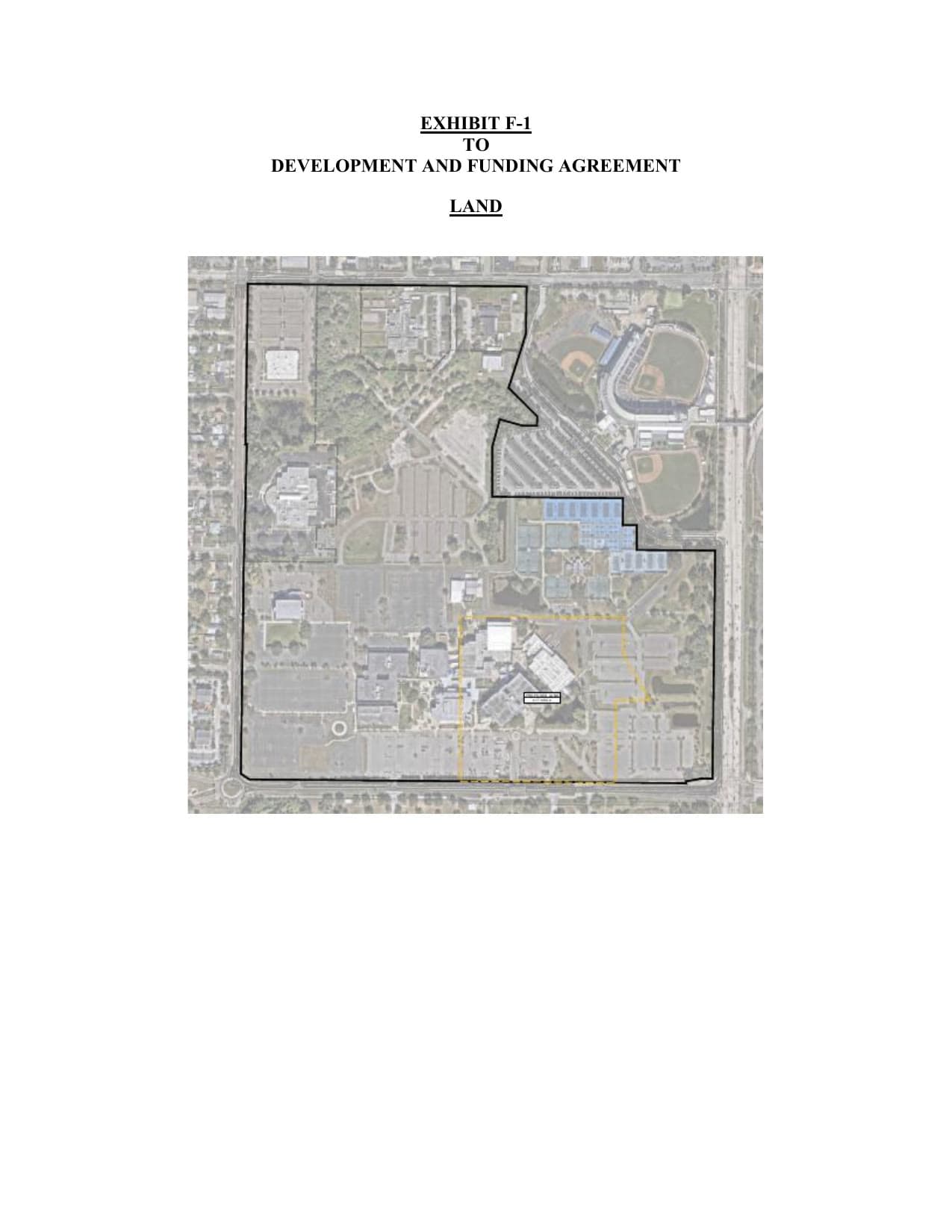
The ballpark would sit on about 21.5 acres of Hillsborough College’s roughly 115-acre Dale Mabry campus in Drew Park, across the highway from Raymond James Stadium. The college owns the land. It would ground-lease the campus to StadCo, then convey the stadium parcel to the county after substantial completion. From that date, Hillsborough would own the land and the finished ballpark. StadCo would occupy it under a separate license and use agreement that Mandell said still needs additional approval. The package is built around a 35-year initial term and a non-relocation pledge that would generally keep the Rays in Hillsborough while the deal is in effect. WUSF, citing Friday’s documents, reported $4 million a year in rent to the county; that figure is not in the funding agreement’s money sections.
The old plan for the Drew Park Community Redevelopment Area to put $100 million directly into the project is gone. A new Community Development District would instead capture a share of future property-tax growth on the site to service about $100 million in privately placed taxable bonds. The stadium district would be carved out of the Drew Park CRA. The agreement also calls for extending the East Tampa and West Tampa CRAs and cutting Tampa’s future Downtown CRA contribution in half after existing obligations. Those CRA moves need separate votes — the reason for Thursday’s 10 a.m. special call.
The team wants site work this fall and substantial completion by March 31, 2029. AECOM Hunt and Turner Construction are the selected builders. After the government votes, StadCo has 36 months to lock financing or the deal dies.
Community benefits, as published this week
The Rays released a Community Benefits Agreement framework on Aug. 25–26. It is not a finished, enforceable contract. The funding agreement requires separate CBAs and splits the value 65 percent to Hillsborough and 35 percent to Tampa. The team has not put a dollar total on the package. The outline covers housing and anti-displacement help outside the district, local hiring, minority- and women-owned firm participation without published percentage targets, transportation planning, youth baseball and literacy programs, complimentary tickets, and veterans outreach. An advisory committee and a public “community report card” are supposed to track it.
Who has the votes — and what a yes still leaves undone
On Aug. 20, Council voted 4-3 to put the deal on Thursday’s agenda. Alan Clendenin, Naya Young, Luis Viera and Bill Carlson voted yes. Lynn Hurtak, Charlie Miranda and Guido Maniscalco voted no. Florida Politics wrote that if that lineup holds, the agreement has the four votes it needs. Fox 13, after interviewing Carlson, described him as the swing vote. That is a read of the agenda vote and of public comments, not a whip count of Thursday’s funding vote.
The county is less settled. Commissioners Chris Boles and Christine Miller both backed the nonbinding May memorandum. Before the definitive papers were public, Boles told the Tampa Bay Times he was prepared to vote no “as it stands today.” Miller stopped short of that. Those comments came before the county posted a revised package late Tuesday. WUSF reported the rewrite adds county safeguards before money is released, more CDD and tax-increment detail, and CRA-extension language left out of Friday’s draft. The community-benefits and ballpark-use papers were still unfinished Wednesday morning.
A yes Thursday and Friday would not finish the project. Tax-increment and CDD ordinances are targeted for mid-December, an interlocal agreement for Jan. 15, 2027, and all CDD approvals by June 30, 2027. Land-use changes, deed restrictions, bond validation and a comprehensive-plan amendment still have to move. A no from either government leaves the Rays without a signed Tampa home and blows the fall site-work window they have said they need for 2029. Commission Chair Ken Hagan has said the city has to go first.
Where to watch Thursday
Council meets at 9 a.m. in chambers at Old City Hall, 315 E. Kennedy Blvd. The Rays item is No. 80. The CRA special call is at 10 a.m. in the same room. The official agenda is at tampa.gov/agendas. The city streams at tampa.gov/livestream and on Spectrum 640 and Frontier 15. Remote speakers must pre-register at tampa.gov/PublicComment.
Hillsborough’s special meeting is set for 9 a.m. Friday at the Frederick B. Karl County Center, 601 E. Kennedy Blvd. County meetings stream at YouTube.com/HillsboroughCountyMeetings, on HTV, and on Spectrum 637 and Frontier 22. Details are at hcfl.gov/government/meeting-information.