
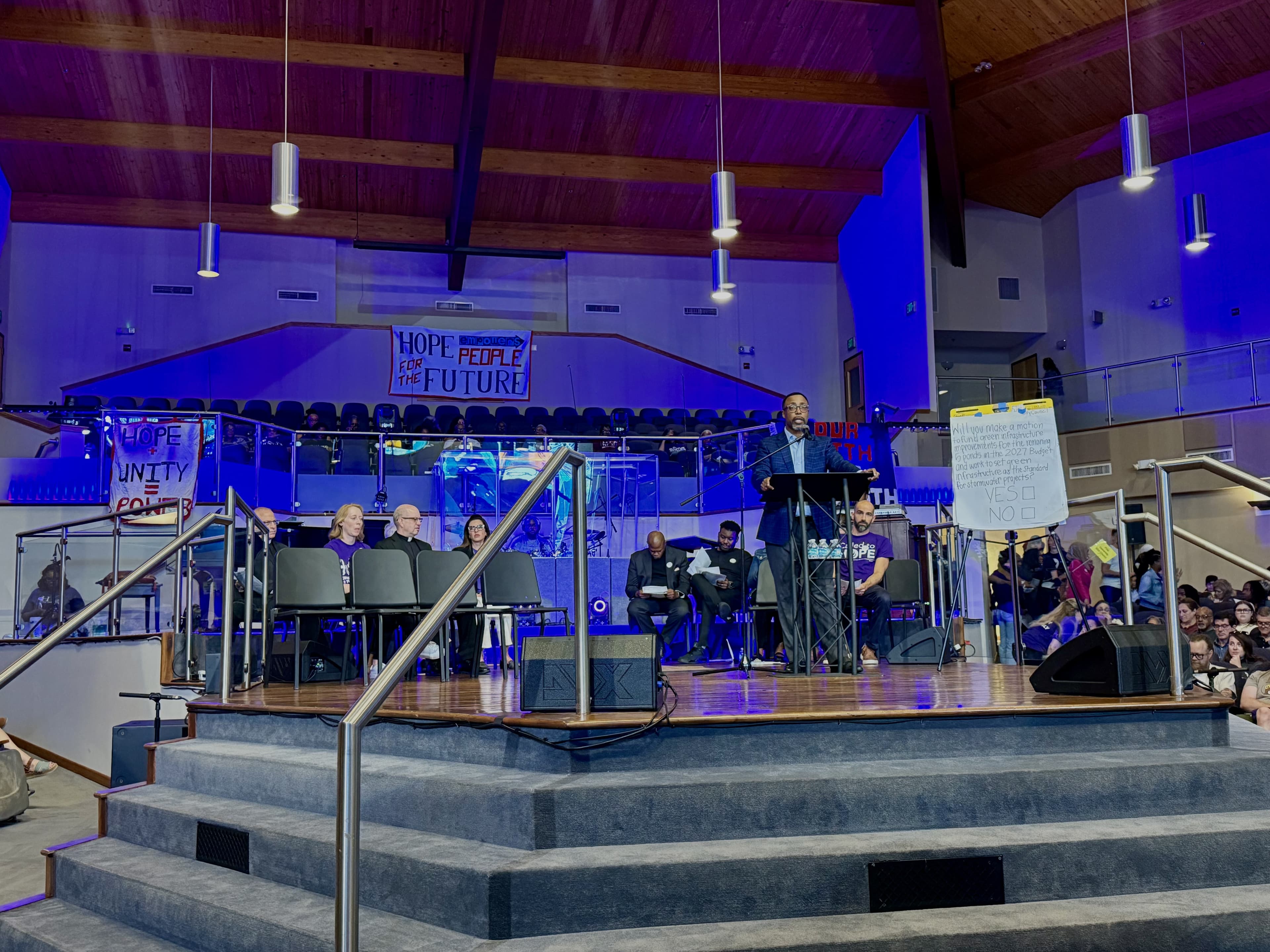
Around 1,000 people gathered for the Hillsborough Organization for Progress and Equality (HOPE) Nehemiah Action, an event where community members listened to school board officials, city officials and Superintendent Van Ayres responses to questions on key concerns including stormwater drainage ponds, youth education and the county’s affordable housing trust fund.
The Nehemiah Action is a face-to-face meeting between residents and decision-makers, designed to directly address issues identified during HOPE’s community listening sessions. The structured event allows no additional questions or comments from the floor, the person being asked the question must answer “Yes” or “No.”
Pastor Chris Kravitz of Bayshore Baptist Church said HOPE held 70 listening meetings across the county to better understand residents’ concerns.
“Parents over and over talked about how complicated special needs education is,” Kravitz said. “Some of those problem areas were long wait times for assessments, miscommunication or none at all. Basically, a lack of clarity and not knowing who to communicate with or how to communicate concerns.”
When arriving at Bible-Based Fellowship Church, in Carrollwood, attendees gathered with their congregation and waited for the questions to begin.
Stormwater Drainage Ponds
Organizers said stormwater flooding remains a concern in several neighborhoods.
Pastor Dr. Ricardo Bain said there are about 240 storm water drain ponds in Tampa, many of which vary in condition and contribute to flooding and health concerns.
Resident Ernest True said he struggles with repeated flooding at his home, where water can rise more than a foot in his yard and take days to drain. He said the water entered his house during heavy rain.
“My family deserves better than this. I wouldn’t wish this experience on anymore. I certainly wouldn't wish that anyone experienced it multiple times during the year and every year,” True said.
Judy Barzlay, a member of the St. Andrews United Methodist Church in Brandon, said increasing trees in the county and using native plants could help reduce runoff and improve water quality.
She said $500,000 in previously allocated funding remains available to address five ponds still awaiting maintenance.
The question asked for city members was: Will you make a motion to fund green infrastructure improvements for the remaining 5 ponds in the 2027 budget and work to set a green infrastructure as the standard for stormwater projects? Yes or no?
All officials in attendance responded yes.
Youth and Education
Concerns about special education services were also raised.
A testimony shared on behalf of an elementary school principal described delays in placing students with autism and other needs into appropriate classroom settings. In one case, a third-grade student remained in a traditional classroom for six months despite a recommendation for a smaller, supportive environment. The student was later placed in that setting and improved academically.
Other speakers shared similar stories about their time dealing with the process for obtaining evaluations and services. They said the process is often slow and difficult to navigate, with limited communication from the district.
The questions for Ayers was: Will you create a direct phone number that parents can call to request an evaluation, get questions answered and have concerns addressed? and track the calls and report twice per year to hope? Will you create a one page flyer and meet with us in June to make a draft?
Ayers said yes to both questions and he provided a rough draft of the flyer.
“The phone number that's created is 837-7777. We serve about 33,000 students with IEPs and just to put into perspective, since July 2025, there have been 5,000 requests for evaluation,” Ayers said. “Thank you for pushing us to do better.”
School board members were asked: Will you support the superintendent in implementing these solutions?
They all said absolutely.
School Board Member Nadia Combs said it's important for students with disabilities to have the right environment to be successful.
Affordable Housing
Affordable housing was another key issue discussed.
A testimony shared on behalf of a family described how rising housing costs led them to sell their home below market value and move into a rental. After being evicted, the parents lived in their car while their three children stayed with relatives.
When attendees were asked if they knew someone who had been forced to leave Hillsborough County due to rising rent, about half raised their hands.
Jackie Coy, St. Pete Claver Catholic Church, said this is a supply and demand issue. She said 54,000 households in the county spend more than half their income on housing, with many others spending more than one-third.
“The housing crisis is not going away. It is persistent and it is growing,” Coy said.
Coy said $4.6 million in approved funds remain uncommitted in the county’s affordable housing trust, along with a 3.67-acre property on North Florida Avenue purchased with public funds.
The question asked for County Commissioner Harry Cohen was: Will you direct staff to ensure specific plans are developed by June 15th so these funds and the N. Florida property is leveraged to create additional affordable housing units for low and very low income?
Cohen said yes, absolutely.
“The county staff is working on this and is expected to bring something back to the board soon, to get this money moving,” Cohen said.
The event concluded at 8:30 p.m. HOPE leaders said progress was made and that commitments from officials addressed key community concerns.