

As writers, filmmakers, and musicians move beyond familiar Southern archetypes, a new generation is reshaping what it means to tell a Southern story.
For generations, the South has been portrayed through familiar images: sprawling porches, small towns, family secrets, church pews, country roads, and complicated characters shaped by history. But a new generation of Southern storytellers is pushing beyond those stereotypes, finding new ways to tell distinctly Southern stories.

The result is a new Southern Arts Renaissance, where literature, music and film cross paths, genres blend, and the definition of a Southern story becomes harder to pin down.
Mark Mustian has been watching that evolution—and helping create it.
An award-winning author and founder of Tallahassee's long-running Word of South Festival, Mustian occupies an unusual place in the Southern creative landscape. Through Word of South, he has spent more than a decade bringing writers and musicians together, creating a space where a novelist might share a stage with a songwriter, a reading can become a performance, and the boundaries between literature and music begin to disappear.
Since its launch in 2015, Word of South has brought together hundreds of authors, musicians and performers representing Americana, country, jazz, gospel, bluegrass, R&B and hip-hop. The festival reflects something that has always been true about the South: its stories have never belonged exclusively to books. They have lived in songs, passed down through church hymns, blues records, country ballads and family legends.
A song can tell the story of a lifetime in three minutes; a novel can spend hundreds of pages exploring the same questions. Word of South puts those traditions back into conversation.
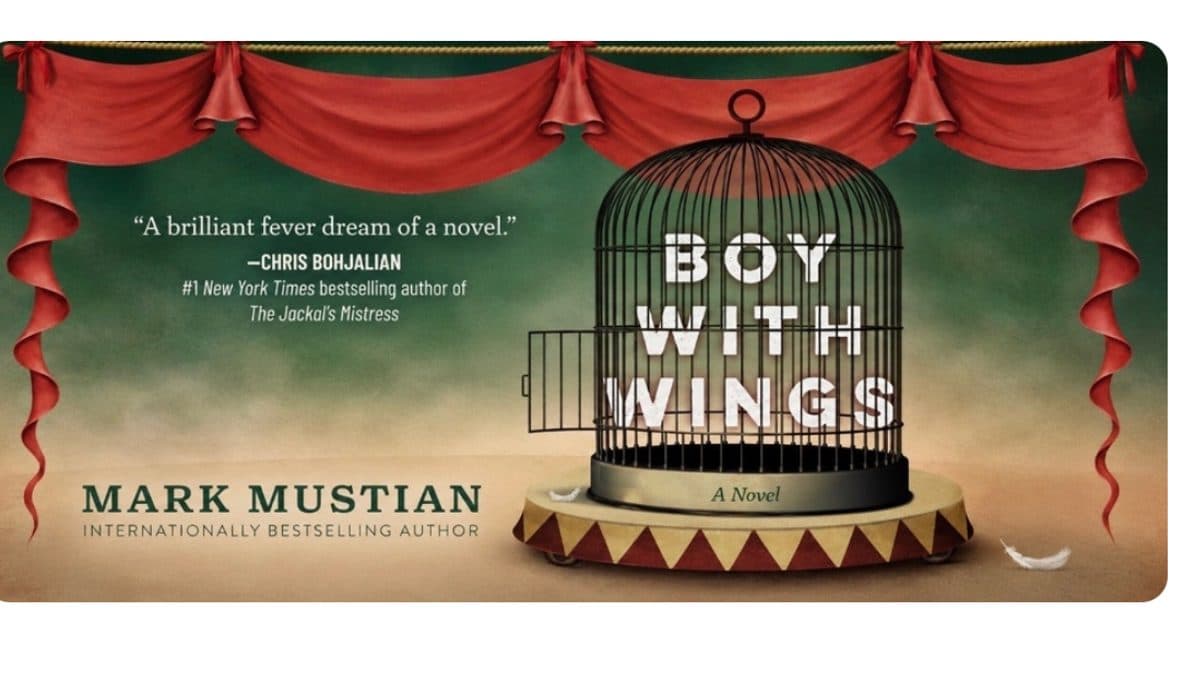
Mustian's own fiction offers another example of what happens when the traditional Southern story is given room to wander. His award-winning novel Boy With Wings begins with a premise that challenges the familiar Southern literary landscape: a boy born with wings.
A Boy Who Doesn't Fit
Set in the Depression-era South, Boy With Wings follows Johnny Cruel, a boy born with strange appendages on his back resembling wings. His difference is met not with wonder, but with fear and superstition. His own mother attempts to bury him alive.
Johnny survives, but there is no easy escape from a world that sees him as something other. He grows up in a brutal turpentine labor camp before eventually joining a traveling freak show, alongside people whose physical differences have made them outsiders.
On the surface, it is a fantastical story. Underneath, it is something much more familiar.
Johnny's wings become a powerful metaphor for how people respond to anyone who doesn't fit their definition of normal. He is feared, exploited and judged. Yet as he encounters others pushed to the margins, the idea of who is truly normal begins to unravel.
The supposed oddities become some of the novel's most human characters, while those who consider themselves ordinary must confront their own prejudices, contradictions and fears.
When Southern Gothic Takes Flight
That tension places Boy With Wings within the tradition of Southern Gothic, a literary form that uses the strange, grotesque and supernatural to expose uncomfortable truths about society.
Southern Gothic embraces the unsettling. Its haunted houses, eccentric characters, violence, decay and supernatural elements reveal what lies beneath the surface: hypocrisy, prejudice, isolation and the darker contradictions of ordinary life.
In Boy With Wings, Mustian combines familiar ingredients (religion, superstition, poverty, race, violence and the grotesque) with magical realism and an unconventional coming-of-age story.
The result doesn't fit neatly on a single shelf, and perhaps that is the point. Johnny's story may be rooted in the 1930s Deep South, but the question at its center is timeless.
Who gets to decide what is normal?
The traveling sideshow adds another dimension. Johnny is surrounded by people who, like him, have been turned into spectacles because they look different. What begins as a parade of curiosities becomes a community of people who understand one another in ways the outside world cannot. For Johnny, difference is initially something to hide. Within this unlikely community, it becomes something that can be understood.
That transformation gives the novel its emotional center, demonstrating how Southern Gothic can examine questions that remain relevant today: belonging, identity, otherness and the human need to find a place in the world.
Beyond the Familiar South
That willingness to reshape old traditions is at the heart of the broader Southern Renaissance. The South has always inspired stories, but today's region is increasingly difficult to reduce to familiar images. It is rural and urban, traditional and experimental, deeply rooted in history and constantly changing. A Southern novel doesn't have to be strictly historical. A Southern film doesn't have to revolve around family drama or small-town life. A Southern musician doesn't have to fit neatly into country or Americana.
Creators like Mustian borrow freely from fantasy, mystery, science fiction and psychological drama. In music, blues, rock, soul, Americana, hip-hop, traditional country and gospel blend into new sounds.
The setting may be Southern; the possibilities are not. And that is where Mustian's two creative worlds, Boy With Wings and Word of South, intersect.
Where Books and Songs Meet
The idea behind Word of South is deceptively simple: bring writers and musicians together and see what happens.
The festival reminds audiences that Southern storytelling has always been bigger than literature. A ballad can carry history. A gospel song can preserve faith and memory. A blues or country lyric can tell a story of heartbreak, survival or loss. A novel can explore those same experiences across generations. Word of South celebrates that common ground while embracing the eclectic sound of the modern South. Its stages welcome musicians working across genres and writers exploring everything from literary fiction to history and popular culture.
Mustian says the festival doesn't insist that Southern music or literature sound a certain way. Instead, it asks what they sound like now. That question matters because the modern South doesn't have one voice; it has thousands.
A South Still Evolving
Perhaps the most interesting thing about the new Southern Renaissance is that it isn't a rejection of the stories that came before. It is an expansion of them.
The old houses are still there, along with the ghosts, songs, family histories, landscapes and complicated relationship with the past. But today's storytellers are looking at those things differently. They are asking new questions of old material, giving outsiders the center of the story, allowing fantasy into historical narratives and bringing music into literary spaces.
Boy With Wings is a striking example. Johnny Cruel's wings make him impossible to categorize. His journey through the Depression-era South takes a familiar literary tradition somewhere unexpected.
Word of South does something similar on a cultural level, bringing together writers and musicians who might otherwise occupy entirely different worlds. Both reflect a South where tradition and experimentation coexist. Maybe that is what makes this moment feel less like a revival of the past and more like a renaissance in the truest sense. The South isn't abandoning its stories. It is discovering how many more stories were there all along.
Check out Boy With Wings at www.markmustian.com and Word of South at https://wordofsouthfestival.com/.